Spice, Light, and Soul: Capturing Marrakech’s Kitchen Heart Through My Lens
Walking through Marrakech with a camera in hand felt like stepping into a living painting—vibrant, chaotic, and deeply human. The moment I smelled cumin dancing in the morning air, I knew this wasn’t just about food. It was about storytelling through spice, shadow, and the hands that shape tradition. What I captured on film wasn’t just cuisine—it was Morocco’s beating heart. Every alleyway hummed with activity, every market stall pulsed with color, and every kitchen told a story centuries in the making. This journey became less about taking pictures and more about bearing witness—to flavor, to light, to the quiet dignity of daily rituals passed from one generation to the next.
The First Frame: A Photographer’s Arrival in Marrakech
Stepping out of Marrakech Menara Airport, the warmth of the Moroccan sun wrapped around me like a familiar blanket, but it was the scent that truly announced my arrival—smoke, orange blossom, and the earthy tang of cumin rising from nearby food carts. The city greeted me not with silence, but with a symphony of honking scooters, distant calls to prayer, and the rhythmic chopping of knives on wooden boards. My senses were immediately overwhelmed in the best possible way, a kaleidoscope of sound and smell that signaled I was no longer in any ordinary place. This was Marrakech: unfiltered, alive, and waiting to be seen.
I had chosen to stay in the Medina, the historic heart of the city, where narrow alleyways twist like ancient veins beneath terracotta rooftops. After navigating the labyrinth with the help of a kind local who insisted on walking me to my destination, I arrived at a small riad tucked behind an unassuming wooden door. The courtyard was bathed in soft morning light, filtered through a lattice of carved cedar wood. It was quiet, serene—a sanctuary from the bustling souks just steps away. Most importantly, the workspace I set up near the central fountain received consistent natural light, ideal for editing photos without the harsh glare of artificial bulbs. This balance of immersion and retreat proved essential throughout my stay.
Initially, I had come to photograph architecture—the ornate zellige tilework, the grand gates, the geometric symmetry of Islamic design. But within hours, my focus shifted. It was the kitchen, not the mosque or the palace, that drew me in. In Moroccan culture, the kitchen is more than a room; it is a gathering place, a site of memory, a vessel of identity. Meals are not rushed but ritualized, each dish layered with meaning. As I wandered past open doorways where women stirred steaming pots, their movements precise and unhurried, I realized I was witnessing something far deeper than cooking. I was watching history unfold in real time, one tagine at a time. The kitchen, I understood, was the true heart of Marrakech—and my lens needed to follow it.
Lens on the Market: Inside Jemaa el-Fna at Dawn
Jemaa el-Fna is often described as the soul of Marrakech, and for good reason. By day, it’s a marketplace of snake charmers, juice vendors, and artisans; by night, it transforms into an open-air dining spectacle. But few see it at its most honest hour—just before sunrise, when the square is still quiet and the vendors begin their meticulous preparations. I made it a ritual to arrive by 5:30 a.m., tripod in hand, to witness this transformation. The air was cool, the light soft and golden, and the energy was one of focused intention rather than performance.
My first subject each morning was the spice merchants. Long before the tourists arrived, these men laid out their wares with the care of artists arranging a gallery. Pyramids of saffron threads glowed like captured sunlight. Mounds of paprika blazed in shades of rust and crimson. Small cloth sacks held ras el hanout, the legendary Moroccan spice blend whose name means 'top of the shop'—a mix so personal that every vendor guards their recipe closely. I crouched low, adjusting my aperture to capture the granular texture of ground cumin, the way it caught the early light like fine sand. These were not just ingredients; they were pigments on a painter’s palette, each with its own story and significance.
Nearby, baskets overflowed with preserved lemons, their wrinkled skins a deep amber, their scent sharp and citrusy. Fresh herbs—cilantro, parsley, mint—were bundled tightly and misted with water to keep them vibrant. I focused on the details: the dew on a sprig of mint, the cracks in a clay bowl holding olives, the way a vendor’s fingers, stained yellow from turmeric, moved with practiced ease. These textures told a story of continuity, of a food culture rooted in patience and precision. Photographing them required slowing down, observing not just what was visible, but what was felt—the weight of tradition in every gesture, the pride in every display.
Cooking Light: The Art of Food Preparation as Visual Storytelling
One of the most profound lessons I learned in Marrakech was that cooking here is not merely functional—it is performative, meditative, and deeply visual. I spent an entire morning with a local chef in a modest kitchen near the spice souk, watching as he prepared msemen, a flaky Moroccan flatbread. His hands moved in slow, deliberate motions: folding the dough, slapping it gently against the counter, brushing it with melted butter. There was no rush, no wasted movement. I set my camera to a slower shutter speed, capturing the blur of his wrist in motion while keeping his eyes in sharp focus. The result was not just a photo of cooking, but of concentration, of craft.
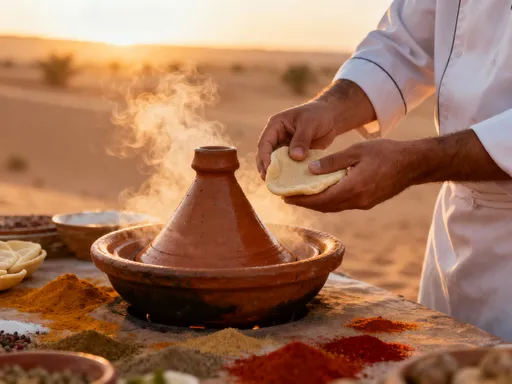
Light played a crucial role in these moments. In the late afternoon, when the sun dipped behind the high walls of the Medina, the interior of the kitchen would darken, save for the warm glow emanating from the tannour, a clay oven used for baking bread and slow-cooking tagines. I remember one evening when a single tagine sat inside, its lid lifted just enough to release a curl of steam that caught the fading light like a whisper. The contrast between shadow and flame was breathtaking—deep blacks punctuated by golden highlights on the rim of the pot, the steam glowing like incense. I used a wide aperture to isolate the vessel, letting the background dissolve into soft darkness. It was a moment of quiet intensity, one that could only be captured by waiting, watching, and respecting the rhythm of the space.
Steam, smoke, and movement became my favorite elements to photograph. A pot of harira soup boiling over an open flame produced rhythmic bursts of vapor that danced in the air. A woman pouring mint tea from a silver pot created a high arc of liquid that caught the sunlight like a ribbon. These were fleeting moments, lasting seconds, but they carried the essence of Moroccan cuisine—warmth, generosity, and a deep connection to the elements. I learned to anticipate them, to keep my camera ready, and to shoot in bursts when the moment arrived. More than technical skill, it required presence. The best food photography, I realized, is not about perfection—it’s about authenticity.
Hidden Flavors: Off-the-Beaten-Path Eateries Worth the Shot
While Jemaa el-Fna is iconic, some of the most meaningful culinary experiences happened far from the tourist trail. One afternoon, while wandering near Souk Semmarine, I followed the scent of cumin and lentils to a tiny stall tucked between a leather shop and a carpet seller. It was run by an elderly couple who served only harira, the traditional soup eaten to break fast during Ramadan. There were no signs, no menu—just a large pot simmering over a gas burner and a few plastic stools. I gestured to ask if I could take a photo, and after a nod, I captured the steam rising from a bowl, the flecks of cilantro floating on the surface, the chipped edge of the ceramic plate. The image wasn’t glamorous, but it was honest.
Another discovery came through a chance conversation with a riad owner, who invited me to a private tea ceremony in her family’s courtyard. The space was lush with potted plants, and mint grew abundantly along the edges of a stone fountain. She plucked fresh leaves with her fingertips, crushed them slightly to release their aroma, and placed them in a tall glass teapot. As she poured boiling water, then lifted the pot high to create foam, I focused on her hands—wrinkled but steady, moving with ritualistic care. I used natural backlighting to silhouette the steam against the sky, turning the moment into something almost sacred. This was not a performance for guests; it was a daily act of hospitality, one that had been repeated for generations.
These experiences raised important questions about ethics in food photography. How does one document a meal without turning people into exhibits? I adopted a simple rule: always ask, always wait, and never publish without permission. In some cases, I showed the subjects my photos on the camera screen before saving them. More than once, I was invited to stay and eat, to become part of the moment rather than just an observer. These interactions reminded me that photography is not just about seeing—it’s about connecting. The most powerful images are those taken with consent, respect, and a shared understanding of dignity.
Color Theory in Action: How Moroccan Cuisine Paints with Ingredients
Moroccan cuisine is a masterclass in color. Every dish is a deliberate composition, where hue signals not just beauty but freshness, balance, and regional identity. Saffron imparts a golden glow to rice and stews, a color so rich it feels luxurious. Beetroot stains salads a deep magenta, while preserved lemons add a bright, citrusy yellow. Green olives and fresh herbs bring cool contrast, and the dark brown crust of a well-cooked tagine provides grounding. I began to see each plate not as food, but as a canvas—one where flavor and form are inseparable.
This visual language is not accidental. In Moroccan markets, vendors arrange their goods with an intuitive sense of color harmony. A basket of red peppers sits beside a mound of yellow onions; a pile of green zucchini rests next to purple eggplants. These combinations are not just pleasing to the eye—they signal variety, seasonality, and care. I found myself adjusting my white balance frequently to ensure my photos reflected these colors truthfully. Under the intense North African sun, colors can appear washed out or overly saturated. Shooting in RAW format allowed me to fine-tune hues during editing, preserving the authenticity of what I had seen.
I also learned to use color as a narrative tool. A photo of a spice vendor’s hands, stained orange from saffron, told a story of labor and tradition. A close-up of a tagine lid, crusted with steam residue, spoke of repeated use and family meals. Even the servingware contributed—hand-painted ceramic bowls, brass trays, woven palm-leaf mats. Each element added a layer of cultural context. By paying attention to color, I was able to create images that were not just visually striking, but emotionally resonant. They invited viewers not only to look, but to imagine the taste, the smell, the warmth of the meal.
Beyond the Plate: People, Hands, and Generations Behind the Meals
As my trip progressed, I realized that the most compelling subject in Moroccan food culture was not the food itself, but the people who made it. The hands that kneaded dough, stirred pots, and ground spices carried the weight of history. I began seeking out portraits—not staged, but caught in the act of creation. One morning, I met a group of women at a communal oven in the Hay Essalam neighborhood. They arrived with dough wrapped in cloths, taking turns baking khobz, the round Moroccan bread. Their faces were lined with age and sun, their movements synchronized like a well-rehearsed dance. I asked permission before photographing, and one woman smiled and nodded, her eyes crinkling at the corners. I captured her profile as she placed a loaf into the oven, her arm dusted with flour, the firelight flickering across her cheek.
These portraits became the emotional core of my project. They reminded me that every meal is a collaboration across time—between the cook and her ancestors, between the family and the land, between the past and the present. A grandmother teaching her granddaughter to roll msemen was not just passing on a recipe; she was transmitting identity. A fisherman cleaning his catch at dawn was not just preparing food; he was honoring a way of life. My role as a photographer was not to capture perfection, but to honor presence. I used shallow depth of field to focus on hands, eyes, and gestures, letting the background blur into soft tones. The result was intimacy, not intrusion.
I also learned the importance of reciprocity. After taking photos, I often returned with printed copies or shared digital files via a local contact. Seeing a vendor’s face light up when he recognized himself in a photo was one of the most rewarding parts of the journey. It transformed the act of photography from extraction to exchange. These moments of connection deepened my understanding: food photography, at its best, is a form of storytelling that honors both the subject and the viewer. It bridges cultures, not by exoticizing, but by humanizing.
From Memory Card to Meaning: Curating a Culinary Journey
Back home, sorting through thousands of images was both exhilarating and daunting. Beauty was abundant, but truth was rarer. I asked myself: which photos told a story? Which ones conveyed not just what Marrakech looked like, but what it felt like? I selected images that formed a narrative arc—from the quiet dawn at Jemaa el-Fna to the golden light of a tea ceremony, from the texture of spices to the lines on a cook’s face. I avoided the overly dramatic or staged, favoring moments of quiet dignity. The goal was not to create a travel brochure, but a visual essay on culture, continuity, and connection.
I organized the final collection into thematic chapters: “Spice,” “Hands,” “Light,” “Table.” Each section flowed into the next, mimicking the rhythm of a Moroccan meal—slow, layered, intentional. When I shared the series at a small gallery event, I included short captions written in both English and Arabic, honoring the language of the people who had welcomed me. The response was deeply moving. Viewers spoke not just of the colors or composition, but of the sense of warmth, of respect, of being invited into a world they had never seen. One woman, of Moroccan descent, told me the photos made her feel closer to her roots. That, more than any exhibition, was the highest compliment.
This project changed how I approach photography. I no longer see my camera as a tool for capture, but as a bridge. It demands patience, humility, and a willingness to listen. In Marrakech, I learned that the kitchen is not just where food is made—it is where stories are preserved, where identity is nourished, where light and shadow dance in service of something greater than taste. To photograph it is not just to document, but to participate.
A Feast for the Eyes and the Soul
Marrakech taught me that food is far more than sustenance. It is memory. It is heritage. It is the quiet act of love passed from hand to hand, generation to generation. Every spice, every flame, every shared meal carries a story that deserves to be seen—not through a lens of spectacle, but through one of respect. As travelers, we have the privilege and responsibility to look closely, to ask before we shoot, and to honor the people behind the plates. Let us taste boldly, yes, but let us also listen deeply. For in the heart of the Moroccan kitchen, I found not just flavor, but meaning. And in that meaning, a deeper understanding of what it means to be human.