You Won’t Believe What I Saw in Sabah
Sabah, Malaysia, isn’t just another tropical getaway—it’s a sensory explosion waiting to happen. I went looking for views, but found moments that rewired how I see nature. From misty highlands at dawn to bioluminescent waves at midnight, every vista felt personal, almost unreal. This isn’t about ticking off tourist spots; it’s about experiencing landscapes in ways most people never do. If you’re craving travel with depth and raw beauty, Sabah’s hidden viewing moments might just be your next obsession.
The Quiet Magic of Mount Kinabalu at First Light
There is a moment—just before sunrise—when Mount Kinabalu seems to hold its breath. Nestled within the Crocker Range in northern Borneo, this UNESCO World Heritage Site rises over 4,000 meters, a jagged silhouette against the fading stars. Most visitors focus on the summit climb, but the true visual revelation happens not at the peak, but from the valley below, where dawn unfolds like a slow unveiling. From vantage points near Kinabalu Park headquarters or along the quieter trails of Kundasang Valley, travelers are treated to a transformation: darkness gives way to soft indigo, then gold, as the first rays strike the mountain’s granite face. The fog, thick and silver in the early hours, begins to curl through the ridgelines like liquid smoke, revealing layers of forested slopes and rocky outcrops only gradually.
What makes this experience so profound is its stillness. While summit climbers begin their ascent in the pre-dawn chill, those who choose to observe from below witness a more intimate performance—one not defined by physical effort but by patient presence. The mountain does not rush; neither should the viewer. As shadows retreat and the peak begins to glow with a warmth that defies the cool air, there’s a sense of witnessing something ancient and unchanged. This is not a staged attraction, but a daily ritual of light and land. The colors shift subtly: rose gold deepens into amber, then pale gold, while the sky transitions from navy to peach to a clear, luminous blue. Bird calls echo in the distance, and the scent of damp earth and wild orchids rises with the warming ground.
For the best experience, arrive at least 45 minutes before official sunrise. The park opens early for this very reason, and local shuttle services often run pre-dawn routes for photographers and nature lovers. Viewing spots such as the Timpohon Gate or the botanical garden’s eastern edge offer unobstructed sightlines without requiring strenuous hiking. To avoid larger tour groups, consider walking a short loop along the Silau-Silau Trail, where elevated clearings provide panoramic angles away from the main road. Dress warmly—temperatures can dip below 15°C (59°F) in the early hours—and bring a thermos of tea or coffee. This is not a moment to rush. It’s one to savor, quietly, as the mountain wakes.
Hidden Waterfall Lookouts Beyond the Main Trails
Waterfalls in Sabah are often marketed as swimming destinations—cooling oases tucked in the jungle, inviting visitors to plunge into emerald pools. But beyond the popular plunge zones lie quieter, more elevated perspectives that transform the way we perceive these natural wonders. Around Poring Hot Springs and the village of Kawayan, a network of lesser-known trails leads to elevated overlooks where waterfalls are framed not by crowds, but by the lush tapestry of the rainforest canopy. These vantage points offer a shift in scale, turning a single cascade into part of a larger, breathing ecosystem.
One such spot is accessible via a guided walk from Kawayan Village, where a moderate 45-minute climb leads to a wooden platform perched above Langanan Waterfall. From here, the fall is seen in full context: a silver ribbon tumbling over moss-covered rocks, disappearing into a misty gorge below. The sound is immersive—not just the crash of water, but the rustle of leaves, the hum of insects, the distant call of hornbills. Unlike the crowded base pool, this overlook offers solitude and a broader visual narrative. You’re no longer *in* the scene; you’re *witnessing* it, as if observing a living painting in motion. The interplay of light and shadow across the wet rock face, the way the mist catches the sun in fleeting rainbows—these are details easily missed when focused on swimming or selfies.
Reaching these viewpoints safely requires preparation. While some paths are well-maintained, others are narrow and can be slippery after rain. Sturdy hiking shoes with good grip are essential, as are light rain gear and insect repellent. Most importantly, travel with a local guide. Community-led eco-tours from Kawayan or nearby villages not only ensure safe navigation but also support sustainable tourism. Guides often share stories of the forest’s medicinal plants, bird species, and cultural significance, deepening the experience beyond the visual. They also help enforce responsible viewing—no loud noises, no littering, no venturing beyond marked paths. These practices protect both the environment and the authenticity of the experience.
The real reward of these hidden lookouts is perspective. When we step back—literally and figuratively—we begin to see waterfalls not just as photo opportunities, but as dynamic forces shaping the landscape. They carve stone, nourish forests, and sustain life far beyond their immediate beauty. And in Sabah, where conservation and tourism walk a delicate line, viewing them with respect ensures they remain wild, powerful, and awe-inspiring for generations to come.
Fireflies and Black Sand: A Night Vision You Didn’t Expect
As daylight fades along the Kinabatangan River, a different kind of magic begins. Far from the bright lights of cities, where the night sky remains unspoiled, the river’s quieter tributaries come alive with flickering constellations—not above, but at eye level. Fireflies, drawn to the mangrove trees that line the banks, transform the darkness into a living light show. Their synchronized flashes pulse like soft lanterns, blinking in rhythm with one another, creating an effect that feels almost choreographed. This is not a spectacle seen from a distance, but one experienced in stillness, from a small wooden boat drifting gently on calm, ink-black water.
What makes this scene even more striking is the contrast of the landscape. The riverbanks are often covered in fine black volcanic sand, a remnant of ancient geological activity in the region. When moonlight touches the shore, the sand glimmers faintly, like crushed obsidian, while the water reflects the fireflies’ glow like a mirror. As your eyes adjust to the low light, details emerge: the silhouette of a monitor lizard slipping into the water, the ripple of a fish breaking the surface, the rustle of leaves as a civet moves through the undergrowth. The air is warm and still, carrying the scent of damp earth and blooming night flowers.
These night cruises are typically offered by community-run eco-lodges along the Kinabatangan, particularly in areas like Abai Village or Sukau, where conservation is prioritized. Unlike commercial tours that flood the river with noise and light, these smaller operations use quiet electric motors or paddle boats and enforce strict no-flashlight rules. The goal is minimal disturbance—not just to the fireflies, but to the entire nocturnal ecosystem. Guides speak in hushed tones, pointing out species with red-filtered flashlights that don’t disrupt night vision. The result is an intimate, almost meditative experience, one that feels more like witnessing a secret than attending a show.
For travelers, this moment challenges the assumption that nature is best seen in daylight. The night reveals a different world—one governed by sound, movement, and subtle light. It also reminds us that some of the most breathtaking experiences require patience and restraint. No shouting, no sudden movements, no phone screens. Just presence. And in that stillness, a deeper connection forms—not only with the environment, but with the quiet wonder of being alive in such a place.
Rice Fields and Morning Mist in the Interior Villages
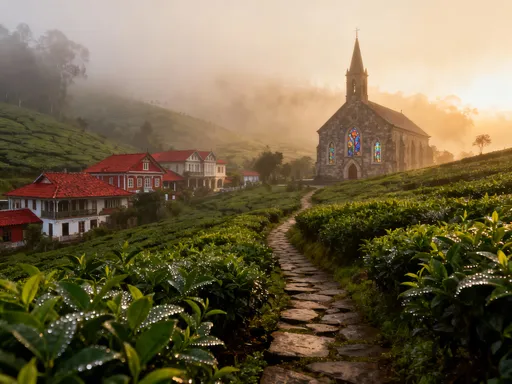
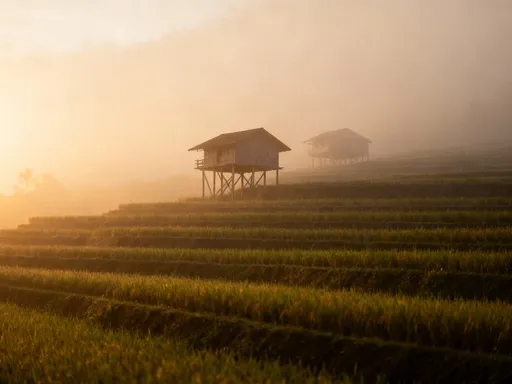
While coastal and mountain destinations dominate Sabah’s tourism narrative, the interior villages near Tenom and Sipitang offer a quieter, equally captivating beauty. Here, the landscape is shaped by generations of agricultural tradition, where terraced rice fields climb gentle slopes and wooden stilt homes perch above winding streams. At dawn, when mist rolls in from the hills, the entire scene softens into a dreamlike tableau. Sunlight filters through the fog in golden shafts, illuminating patches of green paddy, smoke rising from kitchen chimneys, and farmers walking barefoot through flooded fields. There is no stage here, no performance for visitors—just life, unfolding as it has for decades.
Photographers and travelers alike are drawn to this region for its authenticity. Unlike curated cultural villages, these are working communities where tourism plays a minor role. The beauty lies in the ordinary: a child carrying a bundle of firewood, a rooster crowing from a porch, a water buffalo resting under a tree. The morning mist enhances this sense of timelessness, blurring edges and creating a natural soft-focus effect. It’s a reminder that some of the most powerful travel moments come not from grand monuments, but from the quiet dignity of daily life.
Reaching these villages is easier than many assume. Regular buses run from Kota Kinabalu to Tenom, a journey of about three hours through winding highland roads. From there, local minibuses or hired drivers can take you to more remote areas like Melalap or Sipitang’s rural outskirts. Homestays are available in several villages, offering simple but comfortable lodging and home-cooked meals made with fresh, local ingredients. Staying overnight allows for early morning walks, when the mist is thickest and the light most magical.
Respect is paramount. These are not photo studios, but homes. Always ask permission before taking pictures of people or entering private land. Dress modestly, speak politely, and follow local customs—such as removing shoes before entering a house. Many villagers welcome visitors with quiet warmth, happy to share a cup of tea or explain their farming methods. These small exchanges, built on mutual respect, often become the most memorable parts of the journey.
Canopy Walks That Change Your Perspective—Literally
In Danum Valley and Sepilok, elevated walkways offer more than just a thrill of height—they provide a radical shift in perspective. Suspended 30 meters above the forest floor, the canopy walk at Danum Valley stretches over 200 meters, connecting treetop platforms deep in one of the world’s oldest rainforests. From this vantage, the jungle is no longer a wall of green, but a layered, three-dimensional world. You see the crown shyness of dipterocarp trees, their tops avoiding contact like living puzzle pieces. You spot hornbills gliding between branches, orangutans moving through the upper canopy, and epiphytes blooming on high limbs where rain and sunlight meet.
But it’s not just wildlife that becomes visible—it’s weather, light, and scale. From the ground, storm clouds may seem distant. From the canopy, you feel the shift in wind, see the shadow of the approaching front sweeping across the treetops like a wave. The play of sunlight is different too: dappled on the forest floor, but intense and direct above, where leaves shimmer with moisture after rain. The colors are richer, the greens more varied—lime, olive, jade, emerald—each shade indicating a different species or microhabitat.
Safety is carefully managed. The walkways are constructed with sturdy steel cables and wooden planks, regularly inspected by park authorities. Hard hats and harnesses are required at some sites, and access is limited to small groups accompanied by trained guides. These precautions ensure that the experience remains accessible to most travelers, including older adults and families, without compromising conservation goals. The walks are not attractions in the commercial sense, but tools for education and preservation—funded by eco-tourism and used to monitor forest health.
What lingers after the walk is not the height, but the awareness. You begin to understand the rainforest not as a single entity, but as a vertical ecosystem, each layer supporting different forms of life. And you realize how much we miss when we stay on the ground. In Sabah, where deforestation remains a concern, these elevated paths also serve as quiet advocates for protection—showing, rather than telling, why this forest is worth saving.
Sunset from the Edge of the South China Sea
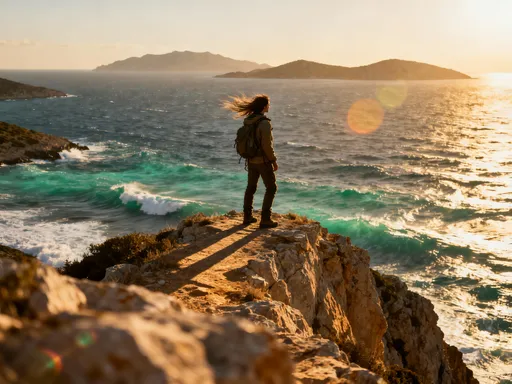
The western coastline of Sabah offers some of the most dynamic sunset views in Southeast Asia. Unlike inland horizons, where mountains block the final descent of the sun, the South China Sea provides an unbroken expanse of water and sky. Near Kota Kinabalu, Signal Hill offers a developed but still effective vantage point, with benches and clear sightlines. But for a more personal experience, the fishing villages along Teluk Kalong or the quiet beaches north of the city provide unobstructed views, free from crowds and artificial light.
What makes these sunsets so captivating is their unpredictability. Sea haze, cloud formations, and occasional distant lightning over the water create a different show every evening. One night, the sky may burn orange and red, the sun sinking like a molten coin. The next, soft pinks and lavenders blend into gray, with streaks of cloud catching the last light like brushstrokes. On stormy evenings, the drama intensifies—dark clouds part to reveal shafts of gold, while distant thunder rumbles across the water, felt more than heard.
For those interested in photography, the golden hour here is forgiving. Even without advanced equipment, a smartphone can capture striking images if held steady and set to HDR mode. The key is timing: arrive at least 30 minutes before sunset to secure a good spot and let your eyes adjust. Bring a light jacket—the breeze off the water can be cool—and perhaps a small snack. This is not a race, but a ritual. Locals often sit on the sand, chatting or reading, treating the sunset as a daily moment of pause. Joining them, even silently, creates a subtle sense of belonging.
These coastal moments remind us that beauty doesn’t always require effort. No hike, no ticket, no schedule—just showing up, and looking. And in a world that often feels rushed, that simplicity is its own kind of luxury.
Why Slow Viewing Beats Checklist Tourism
In an age of travel influencers and bucket lists, Sabah offers a quiet rebellion: the power of staying still. Too often, tourism is measured in stamps—how many countries, how many landmarks, how many photos. But in Sabah, the most lasting memories come not from accumulation, but from attention. It’s in the second glance at a misty rice field, the decision to watch a sunset twice, the choice to return to the same waterfall overlook at different times of day. These acts of lingering transform sightseeing into *sightings*—rare, personal moments when the landscape seems to speak directly to you.
Slow viewing is not laziness. It’s intention. It’s understanding that a mountain changes with the light, that a river reveals different secrets at dawn and dusk, that a village morning has rhythms no guidebook can capture. It’s recognizing that the deepest connections are built not in minutes, but in presence. And in Sabah, where nature remains vast and wild, this approach is not just rewarding—it’s respectful. It honors the land by not rushing through it.
Travelers who embrace this mindset often find that they need less to feel more. One perfect morning in Kundasang, one silent night with the fireflies, one hour on a coastal bench watching the sky—these can outweigh dozens of hurried stops. They stay in the mind, not because they were extraordinary by default, but because they were truly seen.
So if you’re planning a journey to Sabah, consider this: don’t just go to see. Go to *witness*. Leave room for the unplanned, the quiet, the repeated. Let the mountain breathe. Let the river glow. Let the mist settle over the fields without reaching for your phone. Because the most unforgettable moments are not the ones you chase—they’re the ones that find you, when you’re finally still enough to notice.